Most routing protocols allow you to advertise a default route, RIP is no exception. This can be useful if you have a single exit point in your network. Let me give you an example:
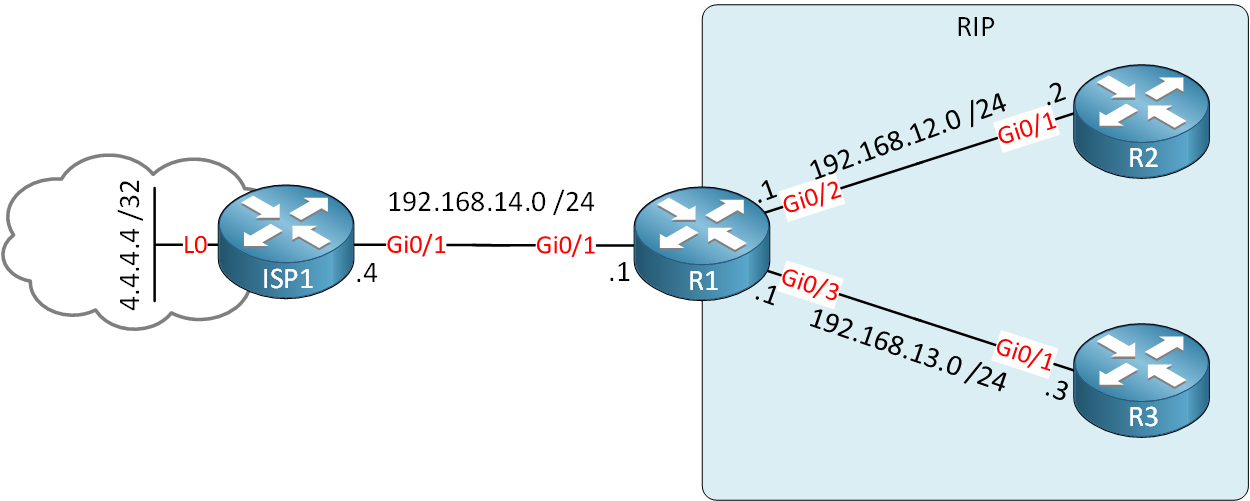
Above we have a customer network on the right side, using R1, R2, and R3. On the left side, there’s the ISP. The loopback on the ISP1 router is supposed to be some network on the Internet.
To reach the Internet, R1, R2, and R3 should have a default route. There are two ways how we can configure this:
- We could configure a static default route on R1, R2 and R3.
- We could configure a static default route on R1 and advertise it in RIP to R2 and R3.
I’ll show you how to configure option 2.
Mục lục
Configuration
Let’s start with a basic RIP configuration for R1, R2 and R3 so that all internal links are advertised:
R1(config)#router rip R1(config-router)#version 2 R1(config-router)#no auto-summary R1(config-router)#network 192.168.12.0 R1(config-router)#network 192.168.13.0 R2(config)#router rip R2(config-router)#version 2 R2(config-router)#no auto-summary R2(config-router)#network 192.168.12.0 R3(config)#router rip R3(config-router)#version 2 R3(config-router)#no auto-summary R3(config-router)#network 192.168.13.0
Let’s configure a static default route on R1 to reach the networks behind the ISP1 router:
R1(config)#ip route 0.0.0.0 0.0.0.0 192.168.14.4
Let’s see if it works:
R1#ping 4.4.4.4 Type escape sequence to abort. Sending 5, 100-byte ICMP Echos to 4.4.4.4, timeout is 2 seconds: !!!!! Success rate is 100 percent (5/5), round-trip min/avg/max = 2/2/4 ms
No problems there. Time to advertise it in RIP:
R1(config)#router rip R1(config-router)#default-information originate
The command above will tell RIP to advertise the static default route.
Let’s see what we have on R2 and R3:
R2#show ip route rip Gateway of last resort is 192.168.12.1 to network 0.0.0.0 R* 0.0.0.0/0 [120/1] via 192.168.12.1, 00:00:26, GigabitEthernet0/1 R 192.168.13.0/24 [120/1] via 192.168.12.1, 00:00:26, GigabitEthernet0/1 R3#show ip route rip Gateway of last resort is 192.168.13.1 to network 0.0.0.0 R* 0.0.0.0/0 [120/1] via 192.168.13.1, 00:00:18, GigabitEthernet0/1 R 192.168.12.0/24 [120/1] via 192.168.13.1, 00:00:18, GigabitEthernet0/1
Both routers have a default route, learned from R1. Let’s test these:
R2#ping 4.4.4.4 Type escape sequence to abort. Sending 5, 100-byte ICMP Echos to 4.4.4.4, timeout is 2 seconds: !!!!! Success rate is 100 percent (5/5), round-trip min/avg/max = 3/3/4 ms R3#ping 4.4.4.4 Type escape sequence to abort. Sending 5, 100-byte ICMP Echos to 4.4.4.4, timeout is 2 seconds: !!!!! Success rate is 100 percent (5/5), round-trip min/avg/max = 3/4/6 ms
Our default route learned through RIP is working.
Conclusion
You have learned how you can use the default-information originate command to advertise a default route in RIP. Make sure you have a default route in your own routing table, otherwise this command will not work.